Hiển thị các bài đăng có nhãn Reading. Hiển thị tất cả bài đăng

For a Longer Life, Go Running.

Thứ Năm, 4 tháng 6, 2015


In this 2012 file photo, Andrea Lemastra, right, and Kim Walsh, left, jog on a wooded park trail with Lemastra's four-year-old son, Luca, in the U.S. state of Ohio. (AP Photo/Mark Duncan)

For a Longer Life, Go Running.
From VOA Learning English, this is the Health and Lifestyle Report.
We all know that exercise is good for your health. But some kinds of exercise may be better than others. 
Running, for example, may help to protect against heart disease and other health problems. Running also may help you live longer.
Researchers say it is not important how far you run. It also does not matter how fast or even how often you run.
As advertisements for the running shoe Nike say, “just do it.”
Recently, researchers studied more than 55,000 adults.About one-fourth of the adults reported running regularly. The study found these runners wereconsiderably less likely than non-runners to die of anyform of disease, including heart disease. In fact, the runners lived, on average, three years longer than the non-runners.
This study lasted 15 years. During that time, more than 3,400 of the individuals died. About 1,200 of the deaths were linked to heart disease, a heart attack or stroke.  
One of the researchers is a man named D.C. Lee. He is an assistant professor of kinesiology, or the science of movement, at Iowa State University. Compared to non-runners, he says, runners showed a much lower risk of dying from some diseases.   
“Compared to non-runners, runners showed 30 percent lower risk of death by any causes, including heart attack, stroke or cancer.  
Also, runners compared to non- runners showed 45 percent lower risk of death by cardiovascular disease, including heart attack and stroke.”
D.C. Lee and the other researchers found that speed, distance and how often one runs made little difference in reducing the risk of death. The runners in the study averaged between 10 and 16 kilometers per hour. Mr. Lee says slower runners, and those who only ran once or twice a week, were helped nearly as much as those who ran faster and further.
“And also we looked at the running over time and we found that persistent runners - over I think six years - they showed the biggest benefits, as well.”
To stay healthy, doctors suggest that adults up to age 65 do 150 minutes of moderate exercise every week. They say these individuals need 75 minutes of vigorous exercise,  like running, every week for good health.
But how complete is this study?
The researchers note that their study was based on the participants' answering questions over the years. The study lacked complete information on what these men and women ate and other facts about their lifestyles.
Researchers say this missing information could have affected the results.Still, they hope their findings will motivate healthy adults to start running, a bit, down the road to a longer life.
Five tips for safe running
Running may be good exercise, but it can be difficult on the body. Here are five commonly shared ideas among fitness experts to reduce the risk of injury for people new to running or jogging.
  1. Take it easy
Do not run too much, too soon or too fast. Most people get running injurieswhen they push themselves too hard. The body needs time to get used to increases in distance or speed. Muscles and joints need time to recover.
  1. Listen to your body
Most running injuries do not come out of the blue. Usually, there are warning signs. They may include body aches, sore muscles and pain that does not go away.
  1. Get good running shoes
There is no single best shoe for every runner. You should find the shoe that offers the best fit and support for your feet. More importantly, you should replace your shoes every 500 to 800 kilometers.
  1. Take good notes
Take some time after each run to write down notes about what you did  and how you felt. Look for patterns, things that happen over and over again.
For example, you may find that your knees ache when you run on consecutive or back-to-back days. But perhaps you feel great when you res tin between running days. These notes will help you identify the best work out for you.
  1. Cross train
 As we said earlier, running is hard on your body. So physical fitness experts suggest some form of cross training to improve muscle balance and to help you stay injury free.
They say swimming, cycling, and yoga are good exercises to combine with running. These exercises are easier on the body.
I’m Anna Matteo.
Jessica Berman wrote this report. Anna Matteo adapted it for Learning English with additional material from RunnersWorld.com.
Are you a runner? Share your thoughts and running tips in the comments section.
________________________________________________________
Words in This Story

regularly – adv. at the same time every day, week, month, etc.: on a regular basis
kinesiology – n. the study of the mechanics of body movements
moderate – adj. average in size or amount: neither too much nor too little
vigorous – adj. done with great force and energy
out of the blue – idiom. without warning; unexpectedly
consecutive – adj. following one after the other in a series : following each other without interruption
workout – n. a period of physical exercise that you do in order to improve your fitness, ability, or performance
fitness – n. the quality or state of being fit or in shape


Source :


Pomegranate: Still Healthy at 5,000 Years Old.

Thứ Năm, 12 tháng 2, 2015


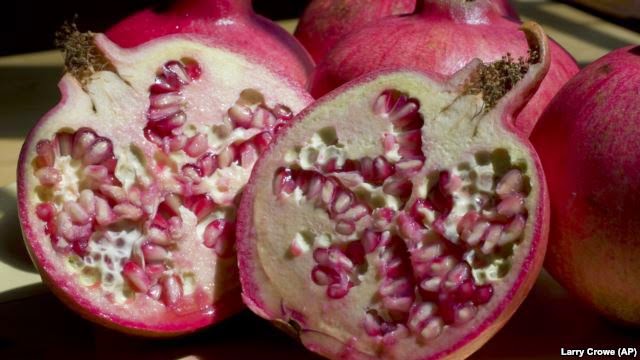
This file photo taken Sept. 3, 3009 shows sliced pomegranate. The ruby red fruit, which resembles a large apple but only its seeds are edible, is in season in September. (AP Photo/Larry Crowe)


Pomegranate: Still Healthy at 5,000 Years Old

From VOA Learning English, this is the Health &Lifestyle report.
The pomegranate is one of the oldest known fruits.Pomegranates are found in ancient writings and pictured in the ancient art of many cultures and religions. The pomegranate is also a symbol of health,fertility and long life.
Experts think the pomegranate is native to northern India, Pakistan, Iran and Afghanistan. Today it also grows in Southeast Asia, the western U.S., Armenia and parts of Africa, among other places.
The skin of a pomegranate is strong. It can be red, purple or orange-yellow. The inside is filled with beautiful dark red seeds that shine like rubies. It is not easy to get them out. But the reward is great.
Health benefits
The pomegranate grows on trees. Parts of the pomegranate tree and fruit are used to make medicine.
The pomegranate is used for many conditions. However, the U.S National Institutes of Health says there is not enough scientific evidence to rate pomegranates as effective for any of them.
Still, in traditional medicine, the pomegranate is used for conditions of the heart and blood vessels, including high blood pressure and “hardening of the arteries.” 
The jewel-like seeds of the pomegranate are loaded with many nutrients and chemicals called antioxidants. These antioxidants remove poisons from the body.
The antioxidants found in pomegranates may help remove build-up of damage in blood vessels. So, it is a very heart-healthy fruit.
Antioxidants slow the progression of age-related sickness and may slow the growth of cancer cells. Men who have prostate cancer may benefit from a daily serving of pomegranate juice.
Pomegranates are used for weight loss and used as a treatment for sore throat . Pomegranates are also high in vitamin K, phosphorus, magnesium,calcium, zinc and iron.
Let’s just say pomegranates are loaded with great things for the inside of your body.
Beauty benefits
But let’s not forget the outside, too!
Pomegranates are great for the skin. They protect the skin by encouraging new skin growth, healing wounds and repairing tissue. Pomegranates protect the skin against sun damage as well. They may help skin look younger by providing moisture and elasticity.


Iranian women in Tehran prepare pomegranates to serve at a celebration for Yalda, the longest night of the year, December 20, 2008. (FILE PHOTO)
Recipes for pomegranates
But how does one eat a pomegranate?
Pomegranates seeds are both sweet and tart. A thick liquid, or syrup, from the pomegranate tastes great with lamb, pork or chicken dishes.
Pomegranate seeds provide extra flavor to salads and other vegetable dishes. The seeds are also delicious in rice and grain dishes. And, of course pomegranates make great desserts. In the U.S., pomegranate juice is often added to sparkling drinks, drinks called smoothies and alcoholic drinks.
Fresh pomegranates are only available in the United States from September to January. They can keep, or remain good to eat, in the refrigerator for about two months if kept in a plastic bag.
I’m Anna Matteo.
Are pomegranates popular where you live? Share recipes or other health and beauty benefits in our comments section!
_____________________________________________________________

Words in this Story

ruby - n. a deep red stone that is used in jewelry : a dark red color
moisture - n. a small amount of a liquid (such as water) that makes something wet or moist
elasticity - n. the quality or state of being elastic
elastic - adj. able to return to an original shape or size after being stretched, squeezed, etc.
tart - adj. having a sharp or sour taste. For example, lemonade without enough sugar is tart.

Related Articles

Zoo Animals Show Their Artistic Sides.

Thứ Tư, 4 tháng 2, 2015


Zoo Animals Show Their Artistic Sides

Can animals be artistic? Some experts think so.Painting and music are part of efforts to keep animals happy at theSmithsonian Institution’s National Zoo in Washington, D.C.

Zookeepers there believe that animals need enrichment just like people do.
A sloth bear called Francois is one of the National Zoo’s resident artists. Hebegan his artistic career two years ago. Francois has a very unusual way topaint – a technique, some would say. He uses his breath to paint.
His zookeeper, Stacey Tabellario, says that although the technique may lookstrange, it is actually a very natural behavior for sloth bears.
“They have got big, big lungs, and they can suck things up and then in thesame breath they can exhale a huge amount of air. So we took this naturalbehavior of the exhale. We stuff up one of those tubes full of paint and askthem to exhale through it. And that expels all of the paint onto the canvas,making these really cool paintings.”
Animal artists come in all shapes and sizes at the Smithsonian’s National Zoo.They use many kinds of techniques to create their works of art. Many use theirpaws or claws -- much like a human painter would use his or her hands. Apesuse paintbrushes.
Stacey Tabellario says Francois seems to enjoy expressing himself throughhis art.
“When I set up the materials for painting activity, he comes and sits next tothem and waits until we are ready to start painting. He does that every time. Ialso see where his eyes go, that he does see the paints come out of the tubeand land on the canvas.”
But not every animal wants to paint. Kenton Kerns cares for animals in thezoo’s small-mammals building.
"Painting is absolutely a choice. So if it is very clear to us if an animal does notwant to do a painting session. And if that's the case, we will stop right away. We will choose other animal(s) and give them an opportunity to do it.”
Music is another part of the arts enrichment program. Ms. Tabellario headsthe zoo’s Enrichment and Training Committee. She says physically andmentally stimulating activities are an important part of the daily care of theanimals. Trainers have a lot of tools, from tablet computers to smallplaythings.
Kenton Kerns says the program helps the animals and the zookeepers inmany ways.
“Every interaction between keeper staff and their animals creates some sortof bond. And hopefully, especially enrichment sessions like this create astronger bond.”
The one-of-a-kind works of art created by the animals are popular with zoovisitors. Many are sold at the zoo’s fund-raising events.
I’m Ashley Thompson.

This report was based on a story from VOA’s June Soh. Ashley Thompsonwrote it for VOA Learning English. The editor was George Grow.
______________________________________________________________
Words in this Story
technique – n. a way of doing something by using special knowledge or skill
exhale – v. to breathe out
one-of-a-kind – adj. unique or special; rare.
fund-raising – n. an activity done to collect money for a political party, charity,school, etc.


Related Articles